Skills-based hiring for infrastructure roles: what it actually takes
Dropping the degree requirement is the easy part. The evidence ladder, the process changes, and the honest costs nobody puts in the framework posts.
hiringrecruiterskills-based-hiringdevops
Skills-based hiring has crossed from HR conference topic to default talking point. Most large employers now say they hire for skills rather than credentials, and the frameworks are everywhere: remove degree requirements, define competencies, add assessments, pilot and scale.
Here is what the framework posts skip: for most teams, skills-based hiring is a sentence in the job ad and nothing else. The degree line comes out, the screening process stays identical, and the same proxies - brand names, titles, tenure - keep doing the actual filtering. The label changed; the funnel did not. Meanwhile the candidates the label was supposed to reach, the self-taught engineers and career switchers with real ability and unimpressive CVs, get filtered out exactly as before.
Infrastructure roles are the best possible place to do this properly, because operating skill is unusually measurable. This post is the honest version of what doing it properly takes.
Skills-based hiring is a recruitment approach in which job-relevant capabilities and evidence of their use carry more weight than degrees, previous employers, job titles or years of experience. For infrastructure roles, that evidence can include observed troubleshooting, safe system changes, automation work and structured explanations of operational decisions.
Why infrastructure is the easy mode
You cannot cheaply verify whether someone is a good product strategist. You can verify whether someone can debug a broken Kubernetes deployment, because you can hand them one and watch. DevOps and SRE skills are demonstrable in hours, not quarters: diagnosis, safe change, automation, incident communication all surface in a single realistic scenario.
That measurability is the entire opportunity. Teams that hire infrastructure roles on demonstrated skill get access to a candidate pool their competitors' filters discard - and that pool contains a disproportionate share of people who learned by running real systems because nobody handed them credentials.
The evidence ladder
The practical core of skills-based hiring is a simple question: for each claim a candidate makes, what is the strongest evidence available? In rough order of strength:
- Observed work in a real environment. Someone watched the candidate operate: a scenario assessment, a work trial, a verified practical credential. Strongest, because the observer can verify the work and reasoning.
- Third-party-reviewed work. Open-source contributions, a proctored practical certification. Strong, slightly indirect.
- Inspectable self-directed work. A homelab writeup, an infrastructure repo, a published post-mortem. Real signal about judgment; unverified provenance.
- Interview performance. Useful, heavily confounded by confidence and rehearsal.
- Claims. The CV, the LinkedIn profile, the self-rated skills matrix. Zero verification. This is what most funnels actually run on.
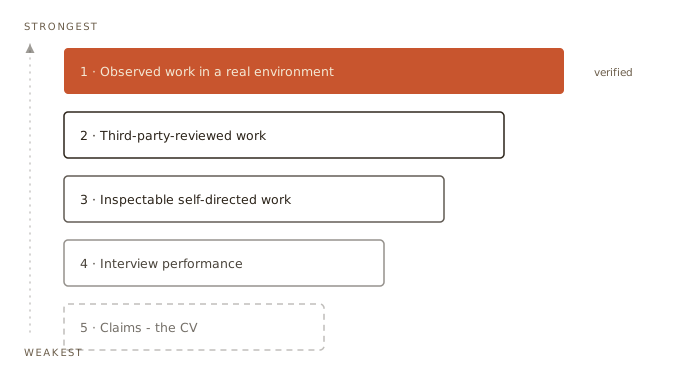
Skills-based hiring, operationally, means moving your decisions up this ladder: making level-1-and-2 evidence available early in the funnel, and demoting level-5 evidence to what it is - a table of contents, not a verdict.
The label changed; the funnel did not.
What changes in the process
The job description changes first. Requirements written as credentials ("BSc, 5+ years, AWS certification") become requirements written as capabilities ("can diagnose a failing deployment from symptoms to root cause; can put a service under version-controlled, reviewed infrastructure"). This is not cosmetic: capability language changes who applies, and it changes what your own interviewers think they are testing.
Screening changes from pedigree-matching to evidence-reading. The recruiter's first-pass question stops being "do the titles look right" and becomes "is there any verifiable evidence attached to this application, and does it match the capabilities we named". That is a genuinely different skill, and recruiters need to be trained for it, not blamed for lacking it.
The assessment becomes the centrepiece, not a checkbox. One realistic scenario in a real environment, scored on process, with a structured follow-up conversation. We wrote the full blueprint in how to assess DevOps engineers without a question bank.
Interviews shrink. Once demonstrated skill is on the table, the four-round gauntlet loses its job. You need the scenario, one conversation about how the person works with others, and one about whether you both want this. Teams that add skills assessment on top of an unchanged interview marathon get the costs of both and the candidate experience of neither.
The honest costs
- It is slower to set up and faster to run. Building capability definitions and a calibrated scenario takes weeks. After that, cycle time usually drops, because the assessment replaces rounds instead of adding to them.
- Interviewer time is real. Observing a scenario costs an engineer-hour per candidate. Budget it; do not bolt it onto goodwill.
- Some hiring managers will resist. Pedigree filtering feels safe because its failures are deniable ("they looked great on paper"). Skills-based failures are visible. Leadership has to actually mean it.
- False negatives change shape. You will pass on some polished CVs that would have worked out. You will also stop passing on the unpolished ones that would have. The trade is favourable; it is still a trade.
What it looks like when it works
The signature of a real skills-based funnel is boring: the shortlist gets stranger and better at the same time. Bootcamp grads next to ex-consultants next to a support engineer with six years of production instincts and no degree. Interviews get shorter. Offer acceptance goes up, because candidates who were assessed on real work trust the team that assessed them. And the first-90-days surprises - the expensive kind - get rarer, because you already watched the person do the job before you hired them.
Where we fit in
SkillBricks is skills-based hiring with the expensive part already built. Candidates on the platform hold verified skill walls: each brick earned in a live, observed, real-environment assessment, tiered by depth, with the full process record behind it. You search by capability - the level-1 evidence at the top of the ladder - instead of by keyword, and candidates stay anonymous until you decide the evidence justifies a conversation.
Use the playbook above regardless; it works with or without us. But if the reason you have not moved to skills-based hiring is the cost of building verification yourself, that is precisely the part we sell.